<?xml version="1.0" encoding="utf-8"?><?xml-stylesheet type="text/xsl" href="atom.xsl"?>
<feed xmlns="http://www.w3.org/2005/Atom">
    <id>https://ageinclusiveweb.netlify.app/blog</id>
    <title>Age Inclusive Web Blog</title>
    <updated>2026-06-10T19:29:27.000Z</updated>
    <generator>https://github.com/jpmonette/feed</generator>
    <link rel="alternate" href="https://ageinclusiveweb.netlify.app/blog"/>
    <subtitle>Age Inclusive Web Blog</subtitle>
    <icon>https://ageinclusiveweb.netlify.app/img/logo.png</icon>
    <entry>
        <title type="html"><![CDATA[Age Inclusive Web]]></title>
        <id>https://ageinclusiveweb.netlify.app/blog/blog/our research</id>
        <link href="https://ageinclusiveweb.netlify.app/blog/blog/our research"/>
        <updated>2026-06-10T19:29:27.000Z</updated>
        <summary type="html"><![CDATA[Socitm workshop research overview]]></summary>
        <content type="html"><![CDATA[<p><em>Published as part of the Socitm workshop series, Norfolk, UK</em></p>
<hr>
<p><img decoding="async" loading="lazy" alt="Age group overview" src="https://ageinclusiveweb.netlify.app/assets/images/age-group-7b301ab854bd52d0c3e59c04e46d9791.jpg" width="1021" height="190" class="img_ev3q"></p>
<p>This project started as a <a href="https://www.socitm.net/" target="_blank" rel="noopener noreferrer" class="">Socitm</a> workshop. What it uncovered was harder to sit with than expected.</p>
<p>Around 40 people took part. There were women all aged 55 and over, based across Norfolk. The findings were not surprising to anyone working in this space. But that is precisely the problem. We already know the barriers. We are still not removing them.</p>
<hr>
<p><img decoding="async" loading="lazy" alt="Age 55 plus participants" src="https://ageinclusiveweb.netlify.app/assets/images/age-55-plus-42ec7dbc0790169da6593610a8ae7ce0.jpg" width="732" height="668" class="img_ev3q"></p>
<h2 class="anchor anchorTargetStickyNavbar_Vzrq" id="where-people-are-struggling-most">Where people are struggling most<a href="https://ageinclusiveweb.netlify.app/blog/blog/our%20research#where-people-are-struggling-most" class="hash-link" aria-label="Direct link to Where people are struggling most" title="Direct link to Where people are struggling most" translate="no">​</a></h2>
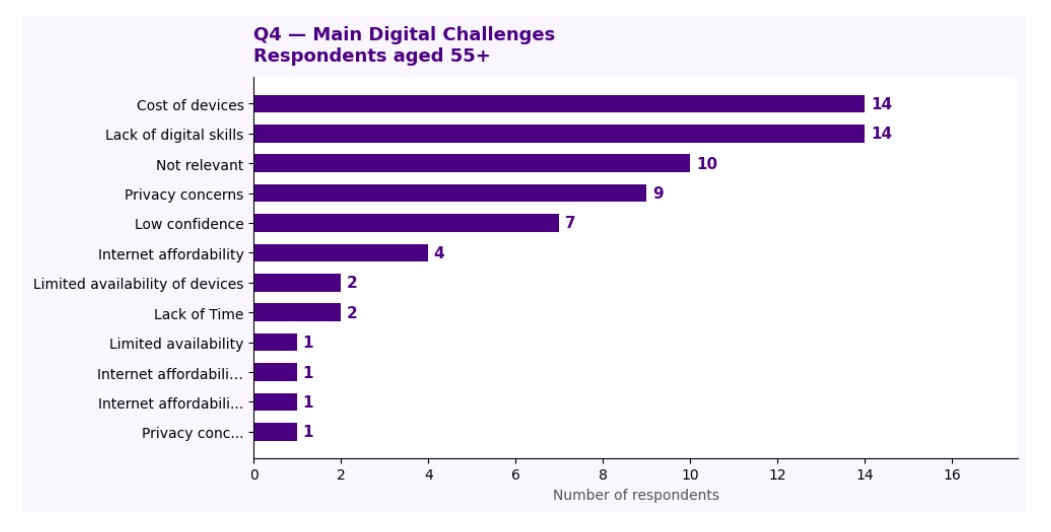
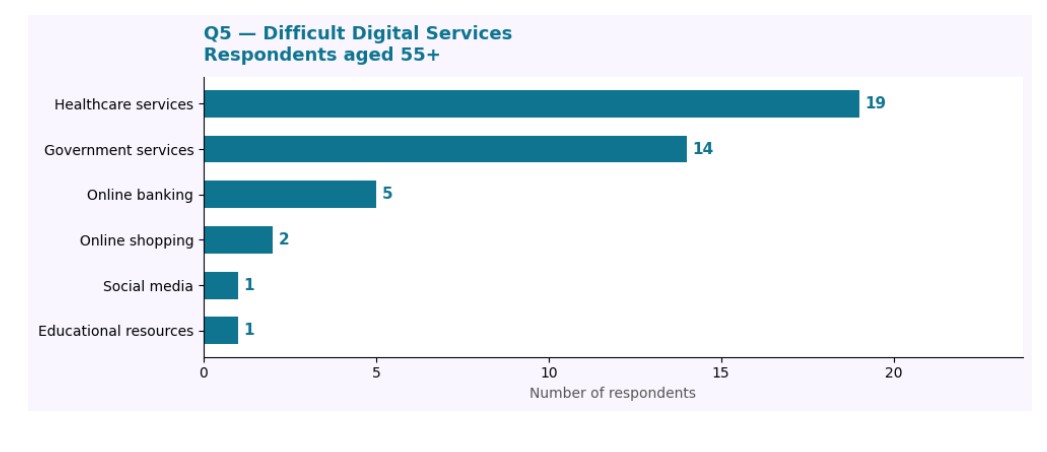
<p>The sharpest difficulties were in two areas: accessing <strong>healthcare services</strong> and <strong>government services online</strong>. Not peripheral services. The essential ones.</p>
<p>When participants were asked why, four barriers came up repeatedly:</p>
<ul>
<li class=""><strong>Cost</strong> - digital devices remain out of reach for many on fixed incomes</li>
<li class=""><strong>Skills</strong> - confidence with online systems was low, and declining</li>
<li class=""><strong>Privacy</strong> - distrust of what happens to personal data online</li>
<li class=""><strong>Confidence</strong> - not just in the technology, but in themselves</li>
</ul>
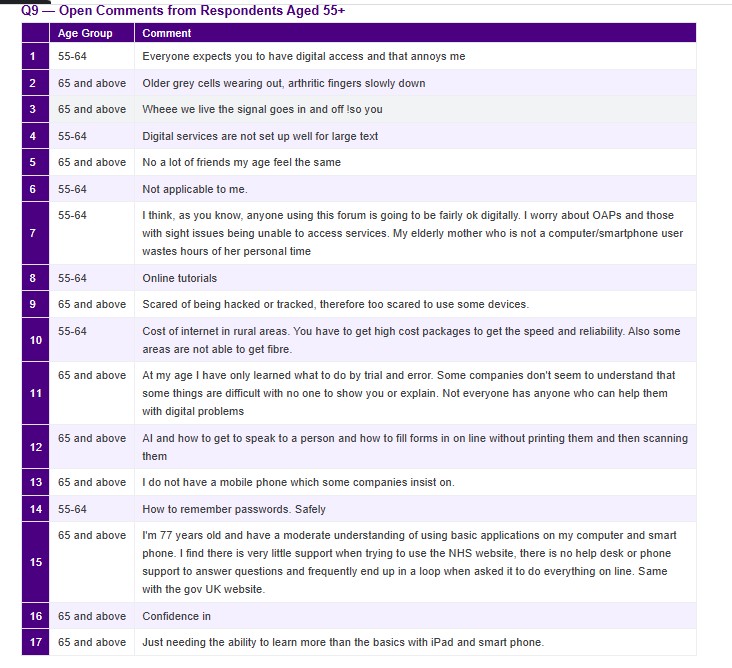
<p>What people said they actually wanted was straightforward: one on one help, online tutorials at their own pace, and small group sessions where questions feel safe to ask.</p>
<hr>
<p><img decoding="async" loading="lazy" alt="Digital challenges faced by users" src="https://ageinclusiveweb.netlify.app/assets/images/digital-challenges-7d5471e455aacd04d403330635350524.jpg" width="1051" height="532" class="img_ev3q"></p>
<h2 class="anchor anchorTargetStickyNavbar_Vzrq" id="why-women-in-particular">Why women in particular<a href="https://ageinclusiveweb.netlify.app/blog/blog/our%20research#why-women-in-particular" class="hash-link" aria-label="Direct link to Why women in particular" title="Direct link to Why women in particular" translate="no">​</a></h2>
<p>The focus on women was deliberate. Women make up a larger share of older age groups, and on average live longer than men. That means the consequences of digital exclusion like being unable to access a GP appointment, manage a pension, or navigate a council service, fall disproportionately on them, and for longer.</p>
<p>This is not a niche concern. It is a structural one.</p>
<p>The research also looked at what has been tried before. Many previous programmes worked well. Tailored, one on one support consistently produced strong outcomes. Most of those programmes no longer exist. Funding was cut.</p>
<hr>
<p><img decoding="async" loading="lazy" alt="Digital services access" src="https://ageinclusiveweb.netlify.app/assets/images/digital-services-4421b7da2548372cc9bc41a9d522e9c5.jpg" width="1047" height="452" class="img_ev3q"></p>
<h2 class="anchor anchorTargetStickyNavbar_Vzrq" id="what-this-framework-is-trying-to-do">What this framework is trying to do<a href="https://ageinclusiveweb.netlify.app/blog/blog/our%20research#what-this-framework-is-trying-to-do" class="hash-link" aria-label="Direct link to What this framework is trying to do" title="Direct link to What this framework is trying to do" translate="no">​</a></h2>
<p>This project does not have the power to restore budgets or rewrite procurement strategies. What it can do is give designers, developers, and leaders a structured, evidence-based reference to make the case for better practice, and to act on it themselves.</p>
<p>The model here draws on the track record of <a href="https://www.w3.org/WAI/standards-guidelines/wcag/" target="_blank" rel="noopener noreferrer" class="">WCAG</a>. Standards work when they are specific, documented, and tied to real evidence. That is what this framework attempts to be.</p>
<p>No single checklist will fix digital exclusion. But the alternative continuing to build services that shed users as they age is not acceptable either.</p>
<p>An ageing population is not a future problem. It is the present reality. The goal of this work is simple: services that work better for people in later life, built by practitioners who understand why that matters.</p>
<hr>
<p><em>This research was conducted independently following a Socitm workshop. All participant data was anonymised. For questions about methodology or findings, use the contact page.</em></p>]]></content>
    </entry>
    <entry>
        <title type="html"><![CDATA[Research Behind the Framework]]></title>
        <id>https://ageinclusiveweb.netlify.app/blog/blog/Designing for age inclusive digital services</id>
        <link href="https://ageinclusiveweb.netlify.app/blog/blog/Designing for age inclusive digital services"/>
        <updated>2026-06-04T16:33:05.000Z</updated>
        <summary type="html"><![CDATA[The evidence that shaped the Age Inclusive Web Standard]]></summary>
        <content type="html"><![CDATA[<p><em>A review of the evidence behind the Age Inclusive Web Standard</em></p>
<hr>
<p>This framework did not emerge from assumptions. It was built on research from academic research, policy reports, and the work of people who have spent years documenting what goes wrong when digital services are designed without older adults in mind.</p>
<p>What follows is an account of that research, and why it matters.</p>
<hr>
<h2 class="anchor anchorTargetStickyNavbar_Vzrq" id="the-scale-of-the-problem">The scale of the problem<a href="https://ageinclusiveweb.netlify.app/blog/blog/Designing%20for%20age%20inclusive%20digital%20services#the-scale-of-the-problem" class="hash-link" aria-label="Direct link to The scale of the problem" title="Direct link to The scale of the problem" translate="no">​</a></h2>
<p><img decoding="async" loading="lazy" alt="Age group overview" src="https://ageinclusiveweb.netlify.app/assets/images/age-group-7b301ab854bd52d0c3e59c04e46d9791.jpg" width="1021" height="190" class="img_ev3q"></p>
<p>The starting point was <a href="https://www.ageuk.org.uk/globalassets/age-uk/documents/reports-and-publications/reports-and-briefings/active-communities/rb_july13_digital_inclusion_evidence_review.pdf" target="_blank" rel="noopener noreferrer" class="">Age UK's Digital Inclusion Evidence Review</a> (Green and Rossall, 2013). The finding that stayed with us: adults aged 75 and over are more than five times more likely not to use the internet than those aged 55 - 64.</p>
<p>That is not a small gap. It is a structural one. And it compounds. As people age, the services they need most - healthcare, benefits, housing - are increasingly only available online. The less confident someone is digitally, the more they are pushed toward channels that no longer exist, or penalised for using them.</p>
<p>That insight sits behind every guideline in this standard.</p>
<hr>
<h2 class="anchor anchorTargetStickyNavbar_Vzrq" id="cognitive-load-is-not-an-abstract-concern">Cognitive load is not an abstract concern<a href="https://ageinclusiveweb.netlify.app/blog/blog/Designing%20for%20age%20inclusive%20digital%20services#cognitive-load-is-not-an-abstract-concern" class="hash-link" aria-label="Direct link to Cognitive load is not an abstract concern" title="Direct link to Cognitive load is not an abstract concern" translate="no">​</a></h2>
<p><img decoding="async" loading="lazy" alt="Digital challenges faced by users" src="https://ageinclusiveweb.netlify.app/assets/images/digital-challenges-7d5471e455aacd04d403330635350524.jpg" width="1051" height="532" class="img_ev3q"></p>
<p>Research published in <a href="https://www.frontiersin.org/journals/psychology/articles/10.3389/fpsyg.2022.931646/full" target="_blank" rel="noopener noreferrer" class="">Frontiers in Psychology</a> made clear what many practitioners already suspect: interfaces that feel fine to a designer in their thirties can be genuinely exhausting for someone experiencing age-related changes in attention and memory.</p>
<p>The research is direct. Interfaces should be easy to learn, support task completion, and minimise unnecessary cognitive demand. Clear visual hierarchy is not a nice to have. It is the difference between a service someone can use and one they abandon.</p>
<p>This is the evidence behind <strong>AIWS-06</strong> : reducing complexity and avoiding information overload.</p>
<p>A <a href="https://www.researchgate.net/publication/220606716_The_impact_of_aging_on_access_to_technology" target="_blank" rel="noopener noreferrer" class="">separate study on ageing and technology access</a> identified the specific cognitive changes that affect digital interaction:</p>
<ul>
<li class="">Reduced working memory capacity</li>
<li class="">Decreased attentional control</li>
<li class="">Difficulty switching between multiple pieces of information</li>
<li class="">Increased sensitivity to cluttered or visually complex interfaces</li>
</ul>
<p>These are not edge cases. They are normal features of ageing. Designing around them is the baseline, not the ambition.</p>
<hr>
<h2 class="anchor anchorTargetStickyNavbar_Vzrq" id="it-is-not-just-about-age">It is not just about age<a href="https://ageinclusiveweb.netlify.app/blog/blog/Designing%20for%20age%20inclusive%20digital%20services#it-is-not-just-about-age" class="hash-link" aria-label="Direct link to It is not just about age" title="Direct link to It is not just about age" translate="no">​</a></h2>
<p><img decoding="async" loading="lazy" alt="Age 55 plus participants" src="https://ageinclusiveweb.netlify.app/assets/images/age-55-plus-42ec7dbc0790169da6593610a8ae7ce0.jpg" width="732" height="668" class="img_ev3q"></p>
<p>One of the more important findings from the research is that age alone does not predict digital exclusion. The picture is more complicated.</p>
<p>People living alone are 1.75 times less likely to use the internet than those in multi-person households. Those with very poor self-perceived health are 2.15 times more likely to be offline. Social context, confidence, and health all shape how someone relates to digital services, often more than chronological age does.</p>
<p>This matters for how we design. A service that assumes all users aged 65+ share the same needs will fail many of them. The goal is flexibility, services that can accommodate varied circumstances, not just varied ages.</p>
<hr>
<h2 class="anchor anchorTargetStickyNavbar_Vzrq" id="digital-by-default-is-not-working-for-everyone">Digital by default is not working for everyone<a href="https://ageinclusiveweb.netlify.app/blog/blog/Designing%20for%20age%20inclusive%20digital%20services#digital-by-default-is-not-working-for-everyone" class="hash-link" aria-label="Direct link to Digital by default is not working for everyone" title="Direct link to Digital by default is not working for everyone" translate="no">​</a></h2>
<p>The <a href="https://www.ageuk.org.uk/" target="_blank" rel="noopener noreferrer" class="">Age UK Offline and Overlooked report</a> and related Policy Exchange research documented something that should give pause to anyone involved in public service delivery: a significant proportion of older people still prefer telephone or in-person support, even when a digital alternative exists.</p>
<p>That preference is not irrational. It reflects trust, familiarity, and often a history of digital services that did not work well for them.</p>
<p><strong>AIWS-11</strong> exists because of this. Critical information and routes to access must remain available outside digital only channels. That is not a concession. It is a requirement.</p>
<hr>
<h2 class="anchor anchorTargetStickyNavbar_Vzrq" id="forms-are-where-things-go-wrong">Forms are where things go wrong<a href="https://ageinclusiveweb.netlify.app/blog/blog/Designing%20for%20age%20inclusive%20digital%20services#forms-are-where-things-go-wrong" class="hash-link" aria-label="Direct link to Forms are where things go wrong" title="Direct link to Forms are where things go wrong" translate="no">​</a></h2>
<p><img decoding="async" loading="lazy" alt="Digital services access" src="https://ageinclusiveweb.netlify.app/assets/images/digital-services-4421b7da2548372cc9bc41a9d522e9c5.jpg" width="1047" height="452" class="img_ev3q"></p>
<p><a href="https://www.researchgate.net/publication/265753295_Older_Adults'_Experiences_of_Interacting_with_Online_Forms" target="_blank" rel="noopener noreferrer" class="">Research into how older adults experience online forms</a> identified a familiar set of failures:</p>
<ul>
<li class="">No clear summary of what the form requires before users begin</li>
<li class="">Too much competing information on screen at once</li>
<li class="">Insufficient guidance on how to complete individual fields</li>
<li class="">Help content that is either absent or too complex to use</li>
</ul>
<p>These are not obscure edge cases. They are the default state of most government forms. And they land hardest on users who are already less confident.</p>
<p>This research shaped <strong>AIWS-04</strong> (support visibility) and <strong>AIWS-05</strong> (do not move, animate, or interrupt content without user initiation). It also reinforced the case for embedded, contextual guidance. We should have help pages buried three clicks away.</p>
<hr>
<h2 class="anchor anchorTargetStickyNavbar_Vzrq" id="anxiety-is-a-design-problem">Anxiety is a design problem<a href="https://ageinclusiveweb.netlify.app/blog/blog/Designing%20for%20age%20inclusive%20digital%20services#anxiety-is-a-design-problem" class="hash-link" aria-label="Direct link to Anxiety is a design problem" title="Direct link to Anxiety is a design problem" translate="no">​</a></h2>
<p><a href="https://www.nngroup.com/articles/error-message-guidelines/" target="_blank" rel="noopener noreferrer" class="">Nielsen Norman Group's guidance on error messaging</a> and <a href="https://www.nngroup.com/articles/deceptive-patterns/" target="_blank" rel="noopener noreferrer" class="">deceptive design patterns</a> pointed to something that does not always get named directly: digital interfaces can generate anxiety, particularly for users who already feel uncertain.</p>
<p>Error messages that blame users. Visual tricks that push people toward choices they did not intend to make. These patterns are common. For older adults with lower digital confidence, they are not just frustrating, they can end the session entirely.</p>
<p><strong>AIWS-17</strong> addresses tone directly: clear, neutral, non-judgemental language throughout. Not as a stylistic preference. As a requirement.</p>
<hr>
<h2 class="anchor anchorTargetStickyNavbar_Vzrq" id="what-the-evidence-adds-up-to">What the evidence adds up to<a href="https://ageinclusiveweb.netlify.app/blog/blog/Designing%20for%20age%20inclusive%20digital%20services#what-the-evidence-adds-up-to" class="hash-link" aria-label="Direct link to What the evidence adds up to" title="Direct link to What the evidence adds up to" translate="no">​</a></h2>
<p>Across every source reviewed, the same themes kept returning:</p>
<ul>
<li class="">Cognitive load must be minimised (<strong>AIWS-06, AIWS-10</strong>)</li>
<li class="">Memory demands should be reduced through clear structure (<strong>AIWS-05</strong>)</li>
<li class="">Interfaces must be consistent and flexible across devices (<strong>AIWS-03</strong>)</li>
<li class="">Support must be visible, contextual, and easy to reach (<strong>AIWS-04</strong>)</li>
<li class="">Critical services must exist outside digital-only channels (<strong>AIWS-13</strong>)</li>
<li class="">Language must remain clear and non-judgemental throughout (<strong>AIWS-17</strong>)</li>
</ul>
<hr>
<h2 class="anchor anchorTargetStickyNavbar_Vzrq" id="one-thing-the-research-makes-clear">One thing the research makes clear<a href="https://ageinclusiveweb.netlify.app/blog/blog/Designing%20for%20age%20inclusive%20digital%20services#one-thing-the-research-makes-clear" class="hash-link" aria-label="Direct link to One thing the research makes clear" title="Direct link to One thing the research makes clear" translate="no">​</a></h2>
<p>Older adults are not a uniform group. Digital exclusion is shaped by age, health, confidence, household, and history. A framework that treats all users over 65 as identical will fail most of them.</p>
<p>The goal here is to focus on aging users, but still recognise that good design can be complicated.  Ultimately, the goal is to design services flexible enough that no one is excluded when the digital channel does not work for them.</p>
<p>Age inclusive design is not something to retrofit. The evidence has been there for years. This standard is an attempt to act on it.</p>
<hr>
<p><em>All sources referenced above are publicly available. For questions about the research methodology behind this framework, use the contact page.</em></p>]]></content>
    </entry>
</feed>